Running a small business in 2026 means competing with larger companies that often have bigger teams, larger marketing budgets, and dedicated specialists for sales, content, customer service, and operations.
AI is changing that equation.
The right AI tools can help a small business create content faster, automate repetitive work, analyze information, manage customers, produce marketing assets, and make better decisions without immediately adding more staff.
But the challenge is no longer finding an AI tool. There are thousands of them.
The real question is:
Which AI tools actually help a small business save time, reduce costs, and grow?
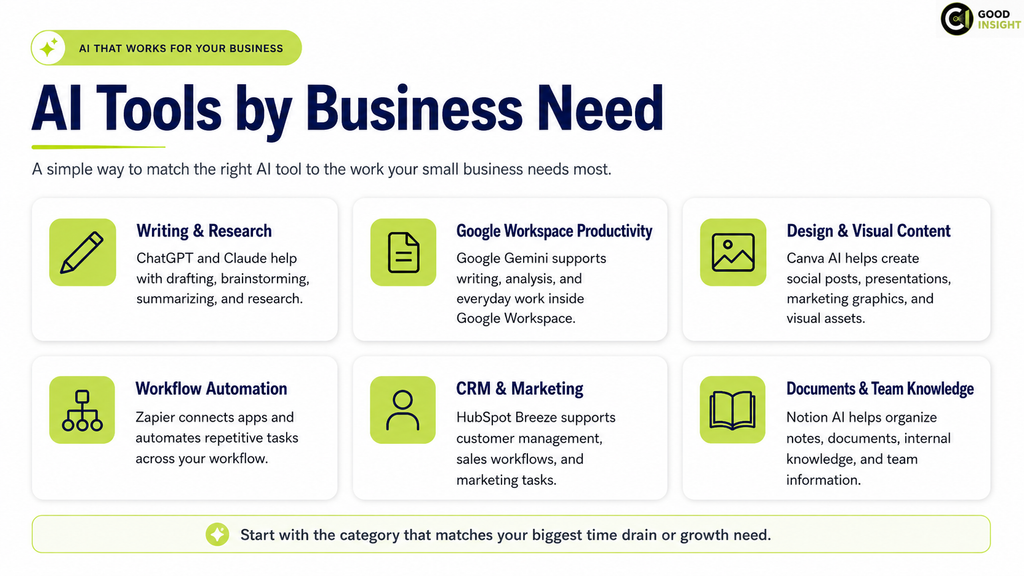
This guide compares seven of the most useful AI platforms for small businesses in 2026.
Table of Contents
Quick Comparison: Best AI Tools for Small Business
| AI Tool | Best For | Main Strength |
|---|---|---|
| ChatGPT | Overall business productivity | Research, writing, analysis, and business tasks |
| Claude | Complex documents and research | Long-form reasoning and knowledge work |
| Google Gemini | Google Workspace users | AI integrated into Workspace applications |
| Canva AI | Marketing and design | Fast visual content creation |
| Zapier | Business automation | Connecting apps and automating workflows |
| HubSpot Breeze | Sales and marketing | CRM-based AI assistance and automation |
| Notion AI | Knowledge and productivity | Documents, projects, and internal knowledge |
1. ChatGPT — Best Overall AI Tool for Small Business
ChatGPT is one of the most versatile AI platforms available to small businesses because it can support many different types of work from a single interface.
A business owner can use it to:
- Research markets and competitors
- Draft emails and proposals
- Create marketing content
- Analyze documents
- Brainstorm products and campaigns
- Summarize reports
- Work with spreadsheets and data
- Generate and review code
- Conduct deeper research
- Build specialized GPTs for recurring tasks
ChatGPT Business also provides shared workspaces, Projects, GPTs, plugins and connected apps, Company Knowledge, Deep Research, and other business-focused capabilities.
Why it works for small businesses
The biggest advantage is versatility.
Instead of purchasing a separate AI product for every small task, businesses can use ChatGPT as a general-purpose assistant across marketing, operations, strategy, research, and customer communication.
Best for
Entrepreneurs, consultants, agencies, online businesses, and small teams that want one general AI platform capable of handling many different tasks.
GOOD INSIGHT Verdict
Best overall choice for most small businesses.
If you are starting with only one AI tool, ChatGPT is one of the strongest places to begin.
2. Claude — Best for Documents, Research, and Complex Work
Claude from Anthropic is particularly useful when a business needs to work with large amounts of information or complete more complex knowledge tasks.
Claude can assist with:
- Reviewing long documents
- Research
- Strategic analysis
- Writing and editing
- Summarizing reports
- Working across business files
- Developing ideas and presentations
- Multi-step knowledge work
Anthropic has expanded Claude beyond traditional chat. Its Cowork capabilities are designed for delegated, multi-step work involving documents, connected applications, and business workflows.
Claude can also work with connected services and research across multiple information sources.
Why it works for small businesses
Small teams frequently have large quantities of information but limited time to process it.
Claude can be especially useful when the task involves reading, comparing, synthesizing, or restructuring complex material.
Best for
Consultants, professional services firms, researchers, content businesses, and companies that frequently work with lengthy documents.
GOOD INSIGHT Verdict
Excellent for deep knowledge work and document-heavy businesses.
3. Google Gemini — Best for Google Workspace Users
Businesses already using Gmail, Google Docs, Sheets, Slides, Meet, and Drive should strongly consider Gemini.
Google continues to integrate Gemini directly into Workspace rather than treating AI as a completely separate application.
In 2026, Google continued expanding AI-assisted capabilities across Workspace products, including tools for drafting content, developing presentations, generating visuals, and supporting video creation.
Practical business uses
Gemini can help teams:
- Draft and improve documents
- Summarize information
- Work with email
- Develop presentations
- Create visual materials
- Analyze business information
- Reduce switching between applications
Why it works for small businesses
The major advantage is integration.
If a company already runs most of its operations through Google Workspace, adding AI inside those existing tools can create less disruption than introducing several completely separate platforms.
Best for
Small businesses heavily dependent on Gmail, Docs, Drive, Sheets, and Slides.
GOOD INSIGHT Verdict
One of the strongest options for Google-centric businesses.
4. Canva AI — Best AI Tool for Marketing and Design
Not every small business can afford a full-time graphic designer or creative agency.
That is where Canva AI becomes particularly useful.
Canva has expanded its AI capabilities beyond basic template creation.
In 2026, Canva introduced Canva AI 2.0 as a research preview, with new capabilities focused on conversational design, agentic editing, brand intelligence, and Canva Code 2.0.
Businesses can also use Canva’s existing AI-powered creative tools to produce and adapt visual content more efficiently.
Small businesses can use Canva for:
- Social media graphics
- Advertisements
- Presentations
- Product images
- Marketing materials
- Short videos
- Promotional campaigns
- Brand assets
Why it works for small businesses
Marketing usually requires a large amount of visual content.
Canva reduces the technical skills needed to create professional-looking materials, making it particularly useful for companies without an internal design team.
Best for
Retailers, restaurants, service companies, creators, ecommerce businesses, consultants, and local businesses.
GOOD INSIGHT Verdict
Best AI-powered creative platform for most small businesses.
5. Zapier — Best for AI Automation
AI becomes much more valuable when it can actually perform work rather than simply generate an answer.
Zapier focuses on connecting applications and automating workflows.
The platform supports connections across more than 9,000 apps and combines traditional trigger-and-action automation with AI-powered workflow steps.
Businesses can use AI inside workflows to summarize information, classify data, draft responses, and support automated decisions.
For example, a small business could create a workflow that:
- Receives a new website inquiry.
- Adds the lead to a CRM.
- Uses AI to classify the inquiry.
- Generates a personalized response.
- Alerts the appropriate employee.
- Updates a spreadsheet or database.
All of this can happen automatically.
Why it works for small businesses
Automation attacks one of the biggest problems small companies face: repetitive administrative work.
Even saving a few minutes across hundreds of repeated tasks can produce meaningful productivity gains.
Best for
Businesses using several SaaS applications that need to exchange information automatically.
GOOD INSIGHT Verdict
Best choice for connecting AI tools to actual business workflows.
6. HubSpot Breeze — Best for AI-Powered Sales and Marketing
HubSpot is widely used for CRM, marketing, sales, and customer service operations.
Breeze adds AI capabilities directly to the HubSpot environment.
HubSpot describes Breeze as its integrated AI platform for completing tasks, generating content, finding information, and supporting automated workflows.
The platform includes Breeze Assistant, AI agents, and other AI capabilities across marketing, sales, and customer service.
Businesses can use Breeze for tasks such as:
- Preparing sales information
- Creating marketing content
- Summarizing customer data
- Supporting meetings
- Managing customer communication
- Automating selected CRM workflows
Because the AI operates inside HubSpot, it can use CRM context that a standalone chatbot may not automatically have.
Availability varies by HubSpot subscription, and some AI agent features may require eligible plans or additional credits.
Why it works for small businesses
Sales and marketing data becomes more useful when AI can work directly with customer information and workflows.
Best for
Small businesses already using HubSpot or businesses planning to build a structured CRM-based sales and marketing system.
GOOD INSIGHT Verdict
Best AI option for businesses that want CRM, marketing, and AI in one ecosystem.
7. Notion AI — Best for Business Knowledge and Productivity
As businesses grow, information often becomes scattered across documents, meetings, project tools, and employee knowledge.
Notion combines documents, project management, and company knowledge within one connected workspace.
Notion’s AI capabilities can help teams search information, manage projects, capture knowledge, summarize content, and automate selected routine workflows.
Notion AI can be useful for:
- Internal documentation
- Meeting notes
- Project planning
- Knowledge management
- Research summaries
- Team collaboration
- Business procedures
- Content planning
Why it works for small businesses
Small businesses often do not need a complicated enterprise knowledge-management system.
A single flexible workspace where documents, projects, and AI can operate together can be much easier to maintain.
Best for
Startups, agencies, remote teams, and businesses managing multiple projects or large amounts of internal information.
GOOD INSIGHT Verdict
Best for organizing company knowledge while adding AI productivity tools.
Which AI Tool Should a Small Business Choose?
You probably do not need all seven.
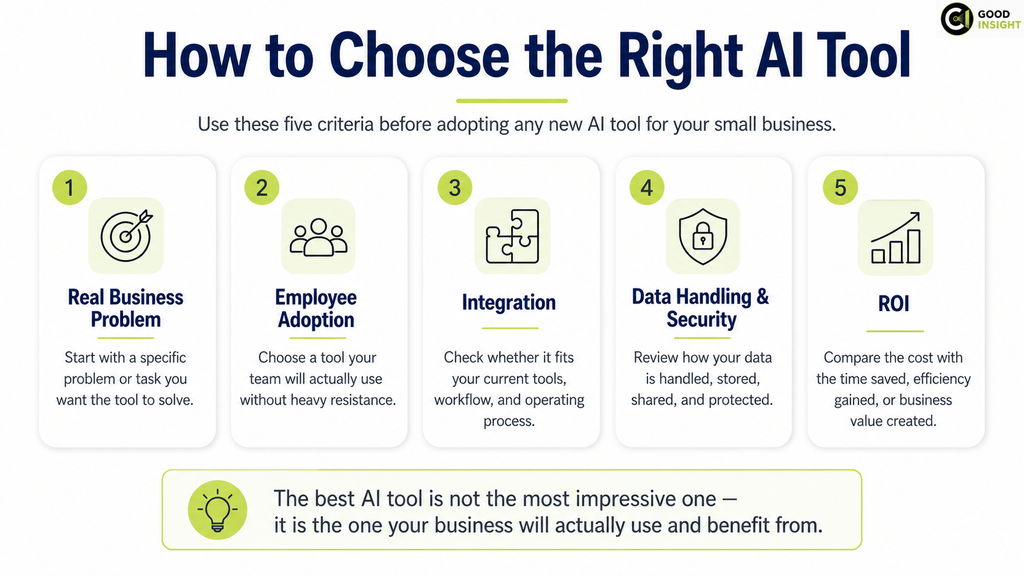
The best approach is to start with the business problem you want to solve.
If you want one versatile AI assistant, start with ChatGPT.
If you work heavily with complex documents or research, consider Claude.
If your business already lives inside Gmail and Google Workspace, Gemini is a natural choice.
If marketing visuals are consuming too much time or money, use Canva AI.
If employees repeatedly copy information between applications, investigate Zapier.
If your priority is customers, leads, and sales workflows, look at HubSpot Breeze.
If your biggest problem is scattered company information, Notion AI may be the better fit.
A Practical AI Stack for a Small Business
For many small companies, a simple combination is more effective than subscribing to dozens of specialized AI products.
A practical starter stack could look like this:
ChatGPT — research, analysis, writing, and general business assistance
Canva AI — design and marketing content
Zapier — workflow automation
HubSpot or Notion — customer management or internal knowledge
The important point is not the number of AI tools you use.
It is how well those tools fit into actual business processes.
What to Check Before Paying for an AI Tool
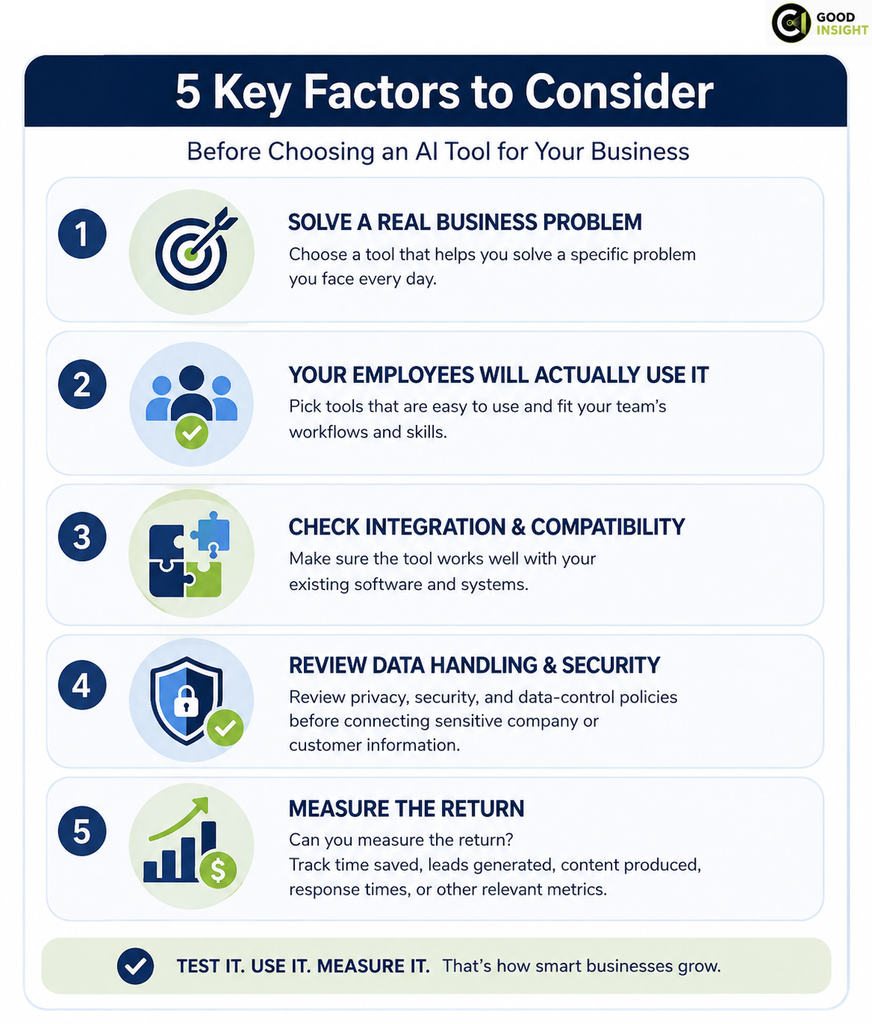
Before committing to any AI platform, evaluate five things.
1. Does it solve a real business problem?
Do not adopt AI simply because a tool is popular.
Identify a measurable problem first: slow content production, repetitive administration, poor lead follow-up, expensive design work, or scattered information.
2. Will employees actually use it?
A powerful tool has little value if the workflow is too complicated.
3. Does it integrate with your existing software?
Integration can be more valuable than an impressive list of standalone AI features.
4. How is business data handled?
Review privacy, security, and data-control policies before connecting sensitive company or customer information.
5. Can you measure the return?
Track time saved, leads generated, content produced, response times, or other relevant metrics.
If you cannot identify an improvement after several months, reconsider the tool.
Final Verdict
The best AI tool for a small business in 2026 is not necessarily the platform with the most advanced technology.
It is the one that removes the most expensive bottleneck from your business.
For most companies, ChatGPT is the strongest general starting point, while Canva AI, Zapier, HubSpot Breeze, Gemini, Claude, and Notion AI become valuable as specific needs emerge.
Start small.
Automate one process.
Measure the result.
Then expand the AI stack only when the business case is clear.
GOOD INSIGHT will continue testing and comparing AI tools, business software, and automation platforms to help businesses choose technology based on practical value—not hype.